A first job at Heavy.com, a bazillion media plans, and the question nobody asks about junior roles: where do you learn what the machine now does?
Read MoreThe Skytribe Engine: How I Build a Fictional World from My Car
A world of mountain islands that sat becalmed for years, the car conversations that got it moving, and what a room of strangers on Reddit told me about it.
Read More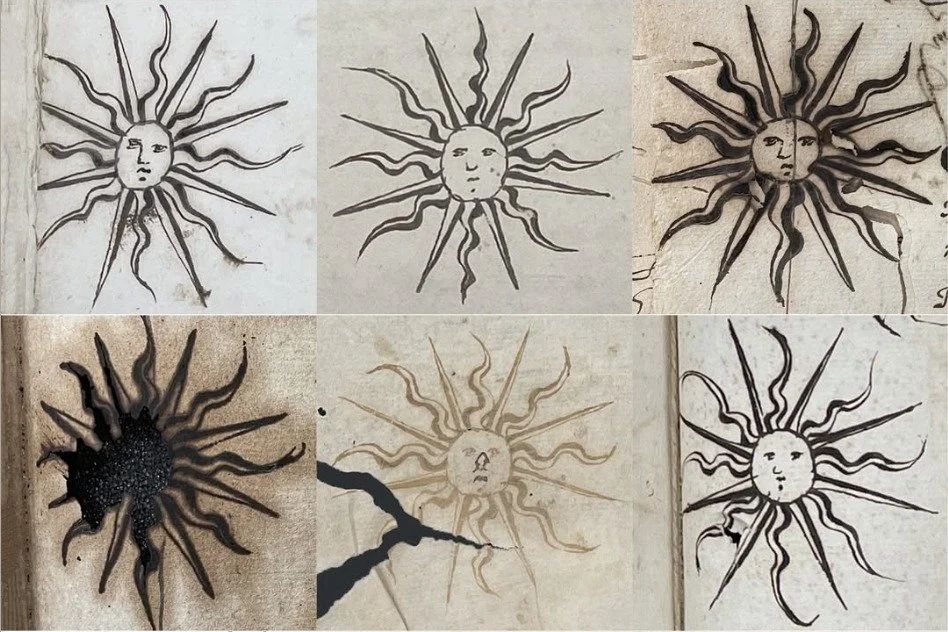
Lucido family icon since at least 1560 AD.
The Admiral's Secretary
The family legend says we descend from a Spanish admiral. The archives say we descend from the guy who wrote everything down.
Read MoreThings That Happened on September 1 (A 2,400-Year List)
A chronological pile of the strange, obscure and enormous things that happened on September 1, from a talking statue in 396 BC to Hurricane Dorian.
Read MoreSetlist Math
Ten songs, two of them TBD, one that sits out on family nights, and a line in the middle that just says [dialogue].
Read MoreThe Card Doesn't Know Who You Are
The rules for Analog Arrivals, written down before the first card leaves the house.
Read MoreSomebody Should Make a Show About a Wildland Fire Crew
A strong opinion about a TV show I've never watched, from a guy who spent a season on a fire crew in Oregon.
Read MoreTrace Evidence
Snow White and the Seven Dwarfs. A Scanner Darkly. Yellow Submarine. What do they have in common? Sure, they’re animated — but more precisely, they were brought to life through rotoscoping.
Rotoscope animation involves tracing over live-action footage frame by frame. It’s slow and a little obsessive. Depending on how far the animator wanders from the original, the final piece can feel hyperreal, dreamlike, or somewhere in between.
In 2022 I started rotoscoping short clips from my phone to see what would happen. Here are a few early experiments. If you have a video you’d like to see in this style, let me know — I’m still learning, and I’d love the practice.
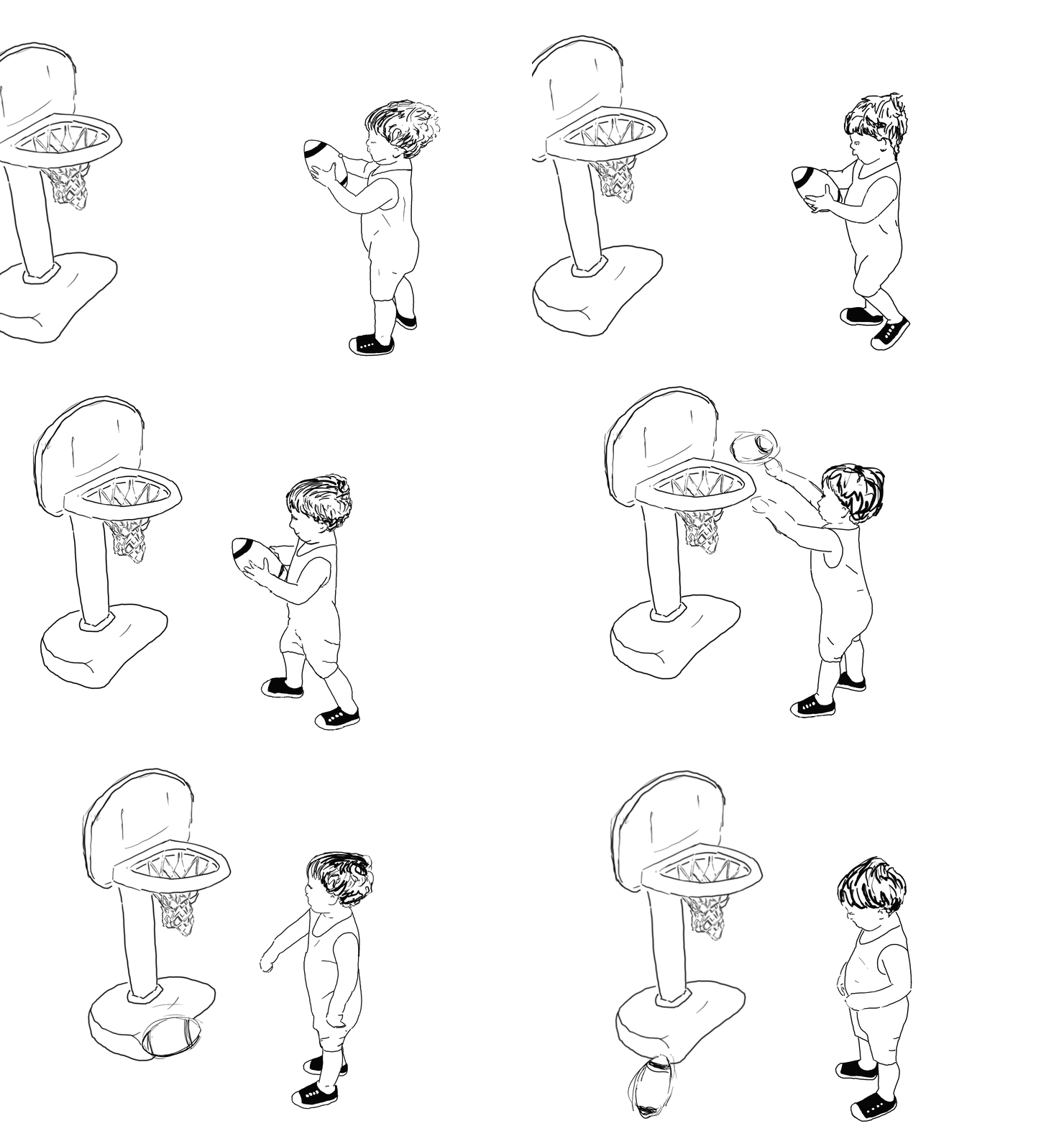
Henry scoring at sportsball.
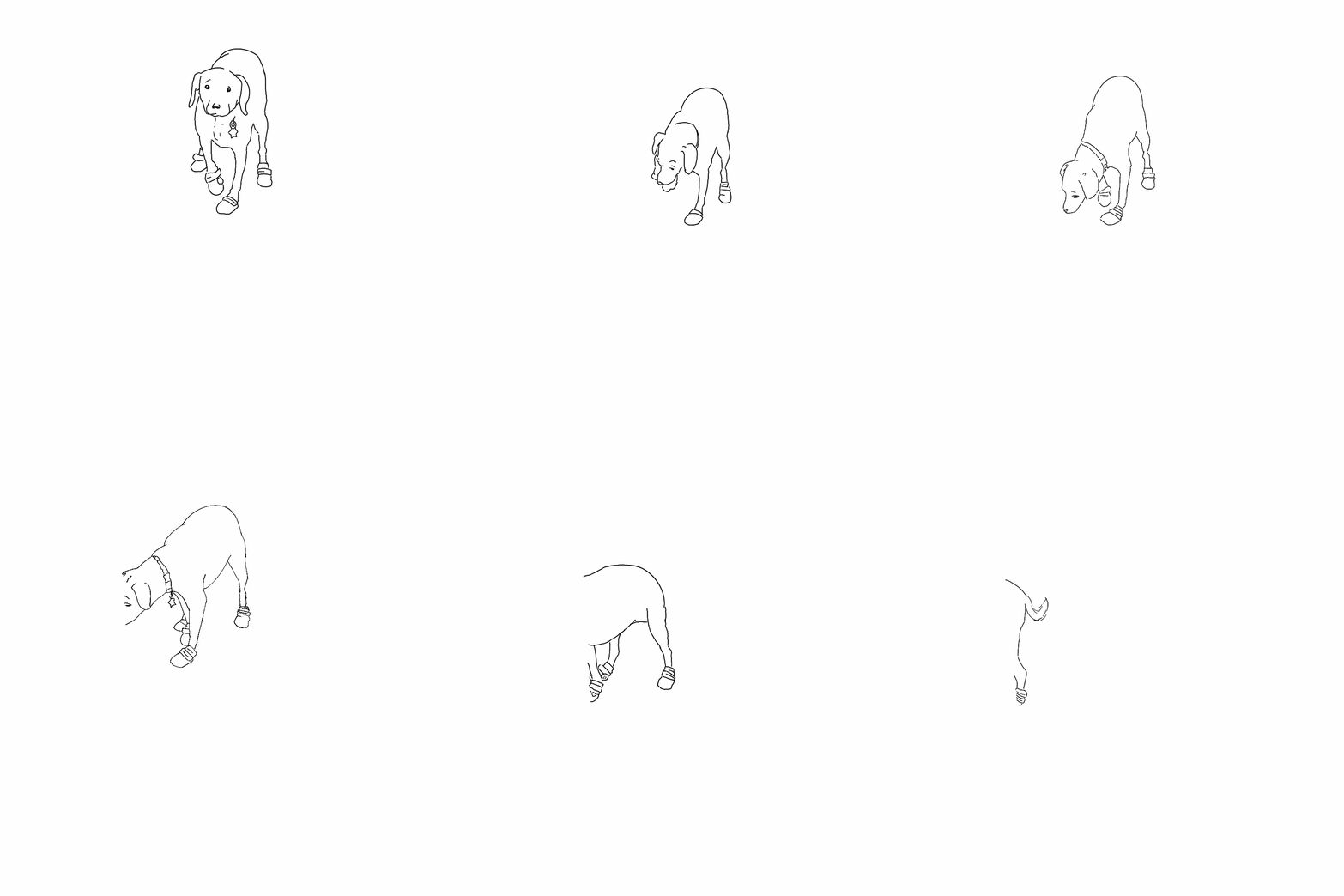
Anna miserable in her new winter boots.
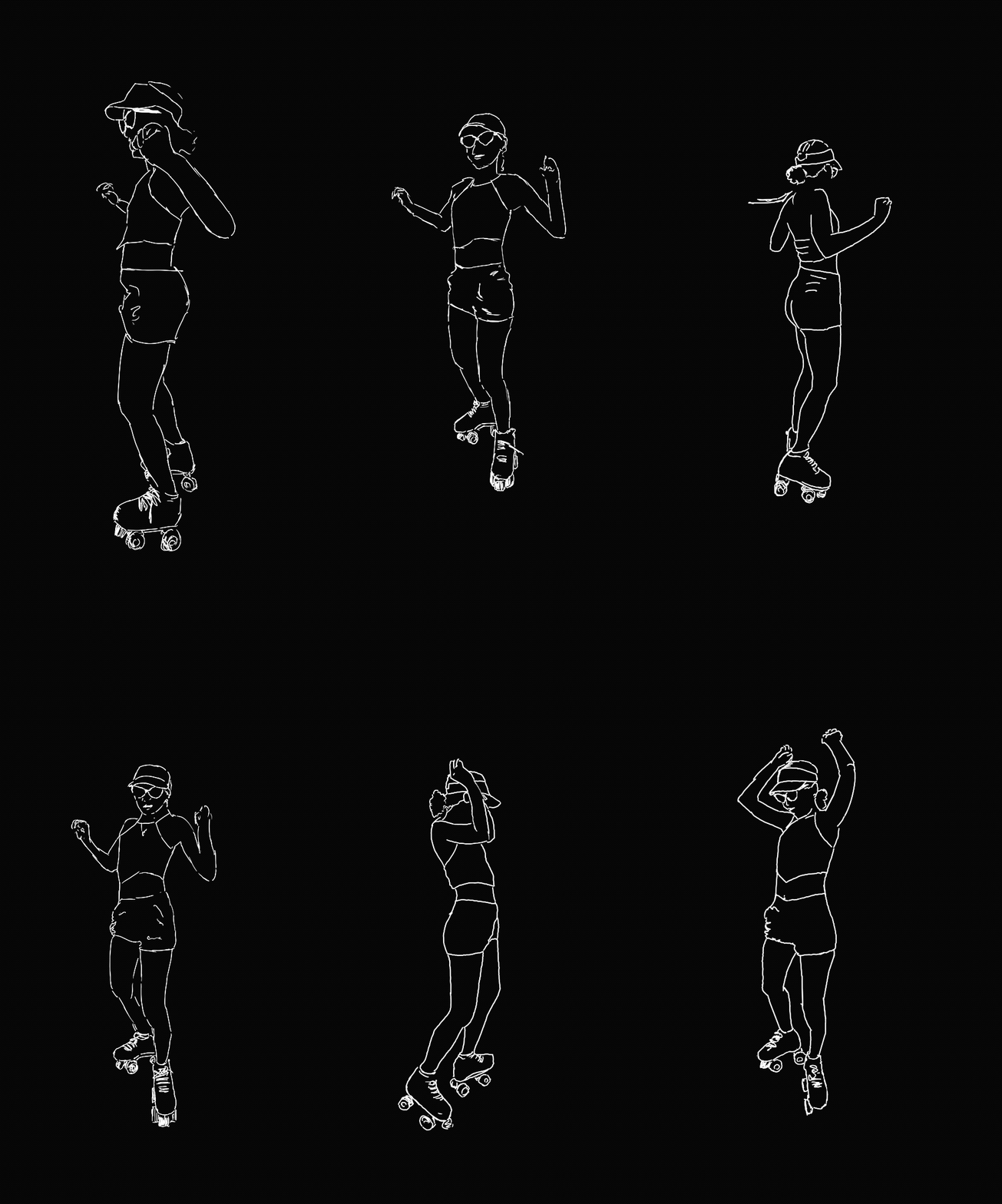
My first commission, courtesy of @melodyskates
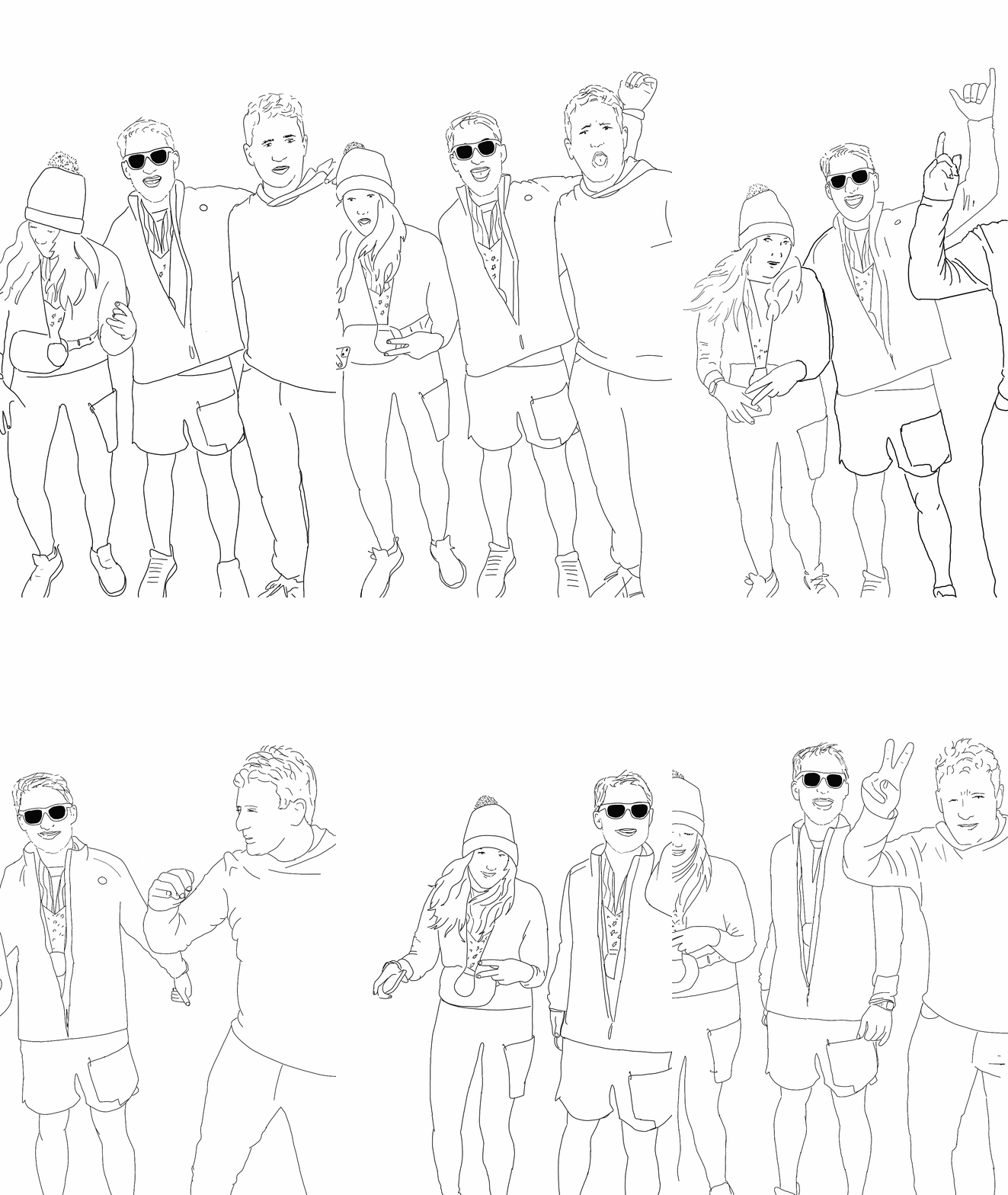
Katie, Jeff and me, post-race.

Rotoscope can also be used to create still frames, like this panorama from a Work & Co happy hour.
Yes I'm weird. So here is my weird cover letter. You're welcome.
I love to write. I love to write letters. I’ve always hated writing cover letters. I’m pretty sure most people do.
The struggle, in my opinion, is sitting at your computer, trying to imagine who the reader will be. More often than not, even the most adept internet sleuth will come up with limited information, at most, about the hiring manager. Maybe they’ll find their job history, or a few articles they’ve written, and (hopefully not) their personal social media. (Eek.) But still, who are they? Do they have a sense of humor? Do they prefer a detailed intro or just want a quick note to know you’re not a psychopath?
How do you write for an audience you know nothing about? Simple. You write for yourself.
When I recently came across a job posting that fit my credentials, I toiled on Google Docs for longer than I’d like to admit, before saying “F*ck it. Let’s do this a new way.” I knew it was a risk to go out on a limb, but the alternative was a boring cover letter I wouldn’t be proud of and was unlikely to help set me apart from the rest of the candidate pool. And this role was, after all, content-focused.
I spent some time gathering screenshots from their blog, opened up a design program, and got to work creating an “article” with tips on how to hire the best Content Marketer. Tips which, you can imagine, supported hiring someone with credentials that happened to match mine. (I even created the key art!)
Did it work? Well, I got an interview (though I bowed out over the location requirement). Perhaps more importantly, however, I was proud of writing something that reflected my personality, my sense of humor and what I can bring to the company. That’s the point of a cover letter.
If they like it, perfect. If they don’t, then they probably won’t like me. And that’s just fine. Onto the next.

8 outstanding product responses to COVID-19
Originally posted to Inside Design.

Designers and developers have a bias towards action—it’s inherent to the job—and when teams are unable to create together, sometimes it feels like your options to contribute don’t extend that far beyond donating. But, in the time since the World Health Organization classified COVID-19 an international public health emergency, designers, developers, and makers have been churning out new products and features. The response has largely been inspiring, as has the velocity with which these products are being built and shared.
A number of community-oriented products have proved that through empathy and innovation, designers and developers are able to help, and help quickly. Here are a few products that are impressive—and that we’re grateful for.
Fighting misinformation: Poynter Institute’s Database and WhatsApp Bot

Designed to easily bring validated and trustworthy COVID-19 info to anyone with a smartphone.
Poynter Institute created a WhatsApp chatbot to connect millions of users with more than 80 fact-checking organizations worldwide to identify trending stories, then sort out truth from myth. Users can check if circulating Coronavirus content has been rated as false by the programs 100+ fact checkers, or submit new information for review. So far the team has identified over 4,000 prominent hoaxes, with more added to their searchable database by the hour.
Employment despite quarantine: CoronaTasks

Quickly filter through options to identify great opportunities for supplemental work.
Unemployment rates have reached epic proportions globally, but CoronaTasks is doing its part to help keep income flowing. The site’s database directs to hand-selected websites where people can earn money at home through a variety of tasks like answering surveys, product testing, translation services, and more.
Order in safely: Takeout COVID

Upleveling at-home dining with richer information and fewer fees than delivery.
Knowing which bistros are still serving and which have shuttered can be the difference between a full belly and a non-essential trip out of the home.
Takeout COVID offers up-to-date information about the status and service options of local bars and restaurants, making it easier for hungry (and thirsty) patron-would-be’s to support their favorite businesses. The product was created as a side project by the team at Coast, as a free, public service to help communities.
Honorable mention: SmartChef
Want to learn to cook gourmet meals at home? InVision’s own Mindaugas Petrutis helped launch, connecting top restaurant chefs with those quarantined at home via virtual dinner parties. Brilliant!
Educating at home: Mango Classroom

A brilliant education strategy to provide help during the pandemic.
With schools closed, kids need resources to keep learning, and teachers need continued help to keep conducting virtual lessons.
While it isn’t a new product, per se, Mango is offering their Classroom online language-learning program for free until the end of the school year, and that certainly is a major shift in product strategy. Might this lead to more users and stronger brand loyalty when schools reopen in the fall? Possibly. If there was ever a time to sacrifice in the short-term to survive for the long, it’s now and Mango seems to understand that.
Reducing panic purchases: Toilet Paper Calculator

A tongue-in-cheek assessment that’s as shareable as it is helpful.
Wash your hands, stay at home, take only what you need! How many times did you hear that in the past few months? With the Toilet Paper Calculator, digital agency Bons found a creative way to discourage stockpiling by helping consumers understand how much tissue their household actually really demands..
Staying positive: Some Good News

Leveraging already-popular platforms to promote an honest-to-goodness reminder of humanity in the world
It’s easy to forget that digital media is a tech product as well. Creators across all platforms have gotten very creative when making new content, offering emotional respite and doling out gratitude for those on the front lines. And laughs. Perhaps the most notable so far has been John Krasinski’s Some Good News on YouTube, because it’s just… a breath of fresh, COVID-free air.
The web series showcases uplifting stories and interviews with A-list celebs, including other alumni of The Office. If you haven’t done so yet, do yourself a favor and go check it out. Great work, Halpert.
Staying sharp—together: Quarantine Book Club

Taking a design-minded approach to revolutionize the typical author Q&A.
Your local independent bookstore may be drive-up or delivery only, but that doesn’t mean you have to go without weekly readings and author Q&As. Started by Mule design co-founders Mike Monteiro and Erika Hall, Quarantine Book Club is a virtual event where people from around the world log-on nightly to hear an author speak on their book and answer questions. Though the programming slate relies heavily on design, authors run the genre gamut, from history to YA fiction.
Keeping “social” in social distance: Netflix Party

Revolutionizing the way people—especially teenagers hungry for their friend groups—are socializing and staying mentally healthy.
Just because school and the office are closed up doesn’t mean movie night needs to be cancelled. With Netflix Party, subscribers can log onto a private, virtual screening room to remotely watch content together with friends in real time, and chat live. Although this chrome extension has been around for several years, the team recently invested in the product backend and new servers to accommodate a tremendous influx of new users.
Similar products are popping up for other platforms as well including Screner for HBO, BBC Together, and Metastream, but Netflix Party stands apart with more than 10 million people attending “parties” so far. We know how important quality time with others is for our psyche, and this is just one excellent way to stay connected.
The collection here barely scratches the surface of all the good work happening now. If you think there’s a new product or feature that should be included here, reach out!
This design leader wants you to know it’s possible to balance creativity, health, and fun—even amidst crisis
Originally posted to Inside Design.
The dog wants a walk. There’s a load of laundry that could be done. And at 11 a.m., the neighbors, for some reason, are singing show tunes at the top of their lungs. Working from home has its own set of perks —and challenges. This is especially true for those trying to manage a team in a creative field during a time of economic uncertainty. But Aja Shamblee has taken the Chicago lockdown in stride. Having led a design team remotely for over a year, she’s no stranger to the #WFH life. And because she launched her career during the 2008 recession, she projects confidence that’s inspiring. Despite all that’s been happening over the past few weeks, Aja’s found an exceptional method to balance work and life. Today, we uncover how Aja got to where she is today and how she’s getting sh*t done in the face of changing times.

Name: Aja Shamblee
Title: Senior Designer, Marketing
Company: InVision
Location: Chicago, IL
Fun fact: Her first name comes from the critically-acclaimed 1977 Steely Dan album
Roommates: John Ingraffia, best friend and partner; Ellie, dog; Soba and Aiko, cats.
How did you get into professional design?

Ellie is very punctual for her walks.
I went to school for game design. I really wanted to create maps and character models and thought I would do the CGI route. The biggest takeaways from those classes were about storytelling, and also learning new tools and exploring the unknown – trying a bunch of things and learning from failure.
I graduated into the 2008 recession—a super fun time for me and my generation. (Sarcasm.) There were no jobs in Ohio, so I moved to Chicago.
In the time since heading to the windy city, I’ve collected a broad range of experiences, from leading learning sessions at the Apple store to design consulting for top-tier agencies, and most recently landing on the marketing team at InVision over a year ago.
Tell us about how you manage. How did you arrive at your management style?
The first person who managed me was super harsh. I wasn’t very good at my craft at the time, and he was blatant about it.
Then the day before a presentation I said to myself, “I’m just going to get this right.” I started Frankenstein-ing all these designs into what I needed and stayed up all night. Afterward, he gave me the first compliment I’d ever had from him, and I thought, “I think I found my process.”
When I left that place, I never looked back, but in my head, I thank him all the time because he really lit the fire under me. It helped me leverage my curiosity and drives me to constantly challenge myself.
My goal is always “How can I be a better person to others who are going through something similar?” Because you can’t get anything out of a designer who feels like crap. I want to empower everyone on my team, to give enough responsibility so as to challenge, and also think about design as a problem-solving skill.
How has anxiety related to COVID-19 impacted how you lead?

Before quarantine, Aja and John ate 70% of their meals at neighborhood spots.
As the only non-parent on my team, I’m extra sensitive to the fact that schedules need to accommodate the new normal. Many have babies, and those with older children are working out ways to entertain and homeschool. We get a few kid cameos during our meetings and it’s honestly really heartwarming to see them. If anything, I now have even more admiration for my team. I feel really grateful that we can all collectively empathize with these changing situations and be flexible for one another.
Before our alignment meetings, we take a moment to just check-in on everyone. How’s everyone feeling? They almost always spin-off to something more personal and you get to know each other on a much more authentic level.
How about outside of work?
I feel oddly prepared for this quarantine. I’m grateful to have worked exclusively from home the last year. I have pretty much developed a system for myself that works. I realize that it’s a privilege to not only do what you enjoy but also to get to do it today while so many are not equipped to work remotely or work in industries that are taking a hit. I feel a lot of gratitude for that.
The things that have changed are my life outside of home. I used to force myself to attend design meet-ups a few times a month and those have gone virtual. My boyfriend and I have been cooking at home a lot more now. Weekends are interesting because I use the same tools to video conference my friends that I use to chat with coworkers. Zoom is where it’s at.
There are whispers of a magic video game room in your apartment. Any truth to these rumors?
The game room is our prized possession. It’s without a doubt our best idea ever.

The game room in all of its glory.
We had this extra bedroom that we were going to turn into an office. But then one day I was browsing Instagram and saw this ad for a handheld projector and it clicked. In lieu of a bedroom and TV, I said, let’s get one of these things and create a game room! The next thing I know my boyfriend said the projector would be there the next day. We set up our PS4 on it and it feels like an event every time we play or watch movies there.
But because it’s a separate room from the living room, it also gives each of us space to separate for a bit while we’re stuck at home. Everyone needs some alone time, whether you’re introverted or extroverted. Seeing as we’re stuck together for the foreseeable future and can’t really escape, the game room has probably saved us from annoying each other to death.
Aja’s tips for staying hopeful and creative during hard times:
Don’t let go of your routine. “Get ready every day, just like you were going into an office. Take a shower, work out, do what you gotta do.”
Take time for yourself. “I make breakfast. I have a bunch of animals to take care of. Before social distancing, I’d go to boxing class, but now I work out at home. Then I read for an hour while drinking coffee before I start work.”
Set up your space for productivity. “As long as I’m working in a really beautiful space, I feel clear-headed. For me, that means a clean and sparse environment. I usually just have a sketchpad and my laptop.”
Find your inspiration. “I love watching sports, and I might see a motion graphic on the screen that will randomly trigger an idea for what I’m working on.“
Give Brain.fm a try. “For those who are looking to tune out and improve their productivity at work. It’s a radio station that plays music to help you focus. I can’t explain the science but it works!”
This transcript has been edited for length and clarity.
5G will disrupt product design—What you need to know
Originally posted on Inside Design
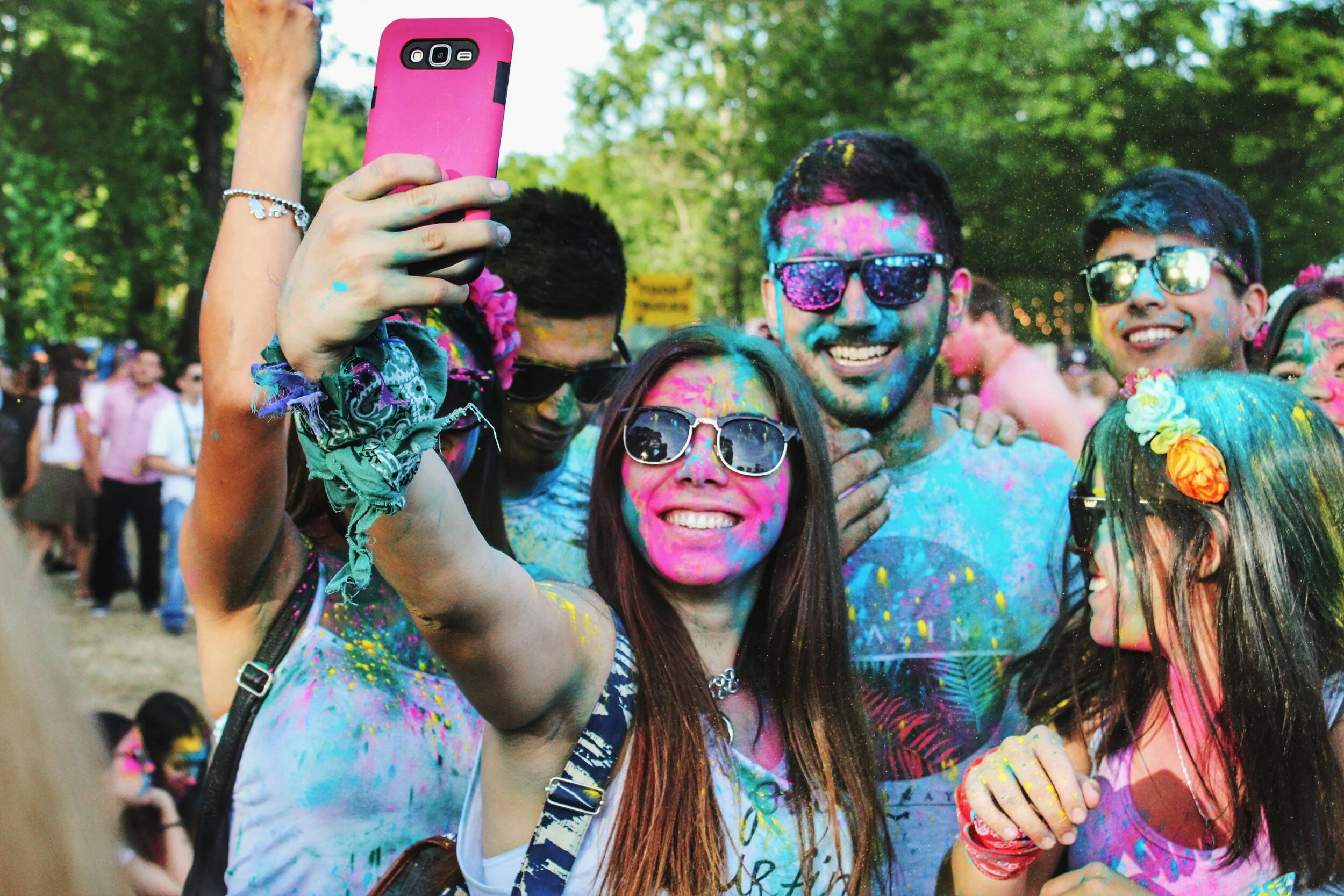
Getting separated from friends at music festivals is as common as the scene’s flower crowns and dudes with too many bracelets. Maybe your friend was too embarrassed to admit they just had to catch the end of the Calvin Harris set, and simply slipped away through the crowd. Or perhaps you didn’t hear them say they were leaving over Big Sean’s bass. Either way, it’s getting dark now and you’d love to make sure they’ll soon be back to the safety of your five-star luxury tent from Walmart, without them slipping in the mud and shattering an ulna. You could text them—if it weren’t for 30,000 attendees updating their Instagram stories, gobbling up those precious service bars.
While this may just be a fun festival anecdote, at its core is a story about our current technology’s limitations. At present, cellular data service needs often exceed the technical capabilities available to users. If you look at your phone right now, there’s a good chance that you’ll see you’re connected to 3G or 4G LTE, today’s standard with a constricted bandwidth.
But pretty soon that’s going to be a thing of the past. Enter 5G, the fifth-generation mobile network. While hailed as a faster and more reliable cell service, it will also catapult us into the next generation of mobile technology, revolutionizing the way the world connects yet again. But on the backend, it will also require designers to rethink how products are built and offer opportunities for innovation.
5G is the next step in the evolution of connectivity
Before I get ahead of myself, let’s lay down the groundwork (and level our expectations.)
Its precursors include…
1G: Voice-only analog connections, first available to the public in the 1980s. It’s the technology that enabled some of Zach Morris’s more famous hijinx.
2G: Added data services to the mix, including SMS on 9 keys, and later, some basic pre-installed apps. Gr8 stuff. ILY T9!
3G: Increased bandwidth paved the way for much more advanced features, products, and devices. There’s an app for that.
4G: A network that, by definition, provides really fast speeds (100mbps.) Since most providers can’t actually reach that speed, they usually offer “4G LTE.” This essentially means “we’re faster than 3G, but can’t quite hit 100mbps.”
And that brings us to 5G. While a few networks launched tests in 2019 (including T-Mobile’s technically-true-but-not-fully-baked “nationwide 5G coverage”), it’s still under development and likely won’t be released until later in 2020 at least. While we won’t be able to play with and fully unlock its potential until then, we can start planning for it in the meantime.
Why is 5G so badass?
For one thing, it leverages three different radio spectrums to optimize for speed and reliability. At the highest spectrum is the millimeter-wave, the frequency catching most of the headlines. You can think of it like WiFi, but like WoahFi: super-fast data transmission limited to a small radius from the antennae. For greater range, the network piggybacks mid- and low-band frequencies, trading speed for coverage, even into remote areas.
In the years to come, service providers will expand their networks across each of these to pack a mean punch into performance.
How does each network stack up?
#allofthespeed
The millimeter-wave is predicted to provide between 1.8Gb and 20 Gb of data per second. That’s somewhere between 5-30x faster than the average connection your phone probably has right now.
#allofthepower
If you think of bandwidth like a car’s top speed, then “latency” is its 0-60 time. 5G latency times are expected to be 10-100x lower (faster) than today.
#alloftheconnections
In leveraging all three spectrums, more devices will be able to connect to a single antenna simultaneously—as many as 100x more.
In short, it has the potential to be more powerful by orders of magnitude.
“Once you have a network this sophisticated and advanced, all that storage, boost, high gear – you don’t need a big, bulky device. When you have this fast speed, no latency, you begin to think differently about the entire architecture of what kind of devices (and products) you design.”
So what does this mean for design?
We can expect incredible new experiences with 5G, but it’s hard to predict what they’ll be until its full power has been unleashed. So, to start, let’s imagine a world where designers, developers, and product managers have some of their biggest limitations removed.
Starting small, there are times today when designers need to consider, say, how much an animated transition will slow down a product. At the higher ends of 5G, this wouldn’t even be a problem.
As richer user flows become more commonplace, our interaction with products and the stories they tell will evolve. Think about how dialog changed when we added emojis to our messages, or directions to nearly any place on earth were made instantly available. Consider how our lives have changed each decade since 1G’s inception.
For instance, the gargantuan bandwidth limits of 5G enable extraordinarily rich experiences. If our devices easily stream YouTube today, what might we stream when we have 100x (or 500x or 1000x) more bandwidth? Might music festivals become obsolete altogether? Why crowd together in the rain or heat, when we can all experience a “front row” 360-degree view from our living rooms? Your friend could “leave” to see Calvin Harris without getting off the couch.
The network’s near-zero latency can truly connect across time and space. The good news for your friend who, it turns out, did in fact shatter their ulna (ouch), is not only might they be able to receive medical advice through a Teledoc service, the remote doctor may be able to even leverage 3D scanning and AI to determine details about the injury before leaving the festival grounds. It might even be possible for a doctor to control a surgical robot in real time a continent away, reacting and critically adjusting as if they were at the operating table.

The possibilities are endless.
There is still time before we see 5G at full throttle. Infrastructure will have to be built, devices upgraded, concerns about cancer quashed. But make no mistake, many of the regions that enjoy 3G and 4G today will have their service supercharged in the years to come. And it will redefine digital experiences, perhaps more than anything since its inception. Thus teams can—and must—start to innovate in new ways.
With that in mind, we’ll need to examine how accessibility will factor into its benefits, too. With radical technological changes, of course, comes a risk of ostracizing communities and individuals without the means to adopt due to financial, geographical, or other limitations. This will be a key consideration in 5G innovations: How can we use this technology to improve the lives of everyone? What are some conversations we can have now so DEI considerations make it into the infrastructure rather than having to be retrofitted? A small, but poignant example: Consider how the Iowa caucus might have played out differently if not for the debacle with unreliable mobile connections in rural areas. This was a case where innovative thinking ran ahead of the actual technical realities of its users. While we won’t have any answers to “How?” at this point, it should be top of mind as we explore our options of what is even possible.
And again, I’m getting ahead of myself: For now, at least, while we still live in a 4G world make sure you and your friends have a meetup plan before the show starts.