Every Sicilian family has an admiral.
Ours came from Caterina Lucido, a Latin and Greek teacher in Trapani, on the western tip of Sicily, who spent years digging into the family before she died in 2007. Her story goes like this. A Lucido ancestor was an admiral for Spain. Or, since Spain didn't technically exist yet, for the Kingdom of Aragon. He was called back. Other admirals who'd been called back had not come home. So before he sailed, he had his will drawn up and left his twin children in the care of their governess.
He didn't come home either.
It's a great story. It has twins, a governess, a summons and a sea. What it doesn't have is a name, a date or a city. Her relatives confirm she told it. Nobody has found the paper.
Nobody told it to me as a kid. By the time it reached me, the admiral had been demoted. I think it was my brother who told me first, and maybe I also saw it on a post somewhere on the Facebook page. Maybe he did too, and that kind of corroborated our story. The way we heard it, we weren't descended from the admiral. We were descended from his secretary. The guy could write.
I told it at my brother's wedding.
I'd been watching a lot of YouTube videos about how to give a best man speech, and it turns out they have a great overlap with stand-up comedy. Timing is everything. So I told the room we were related to a Spanish admiral, and they thought that was cool. Then I corrected myself.
The admiral's... secretary.
They laughed. It was wrong, but it was still fun, and it got a good reaction. (This was well before the days of AI. I mentally LLM'd my way into sounding funny.)
I also told them how great a brother he is, how he taught me everything about cool, and how he was there when the babysitter said, "Nirvana is just saying 'fuck you,' but they say it really cool." [LINK: The Fuck-You Lineage]
The secretary, it turns out, is closer to the truth than the admiral.
The cousin with the archivist
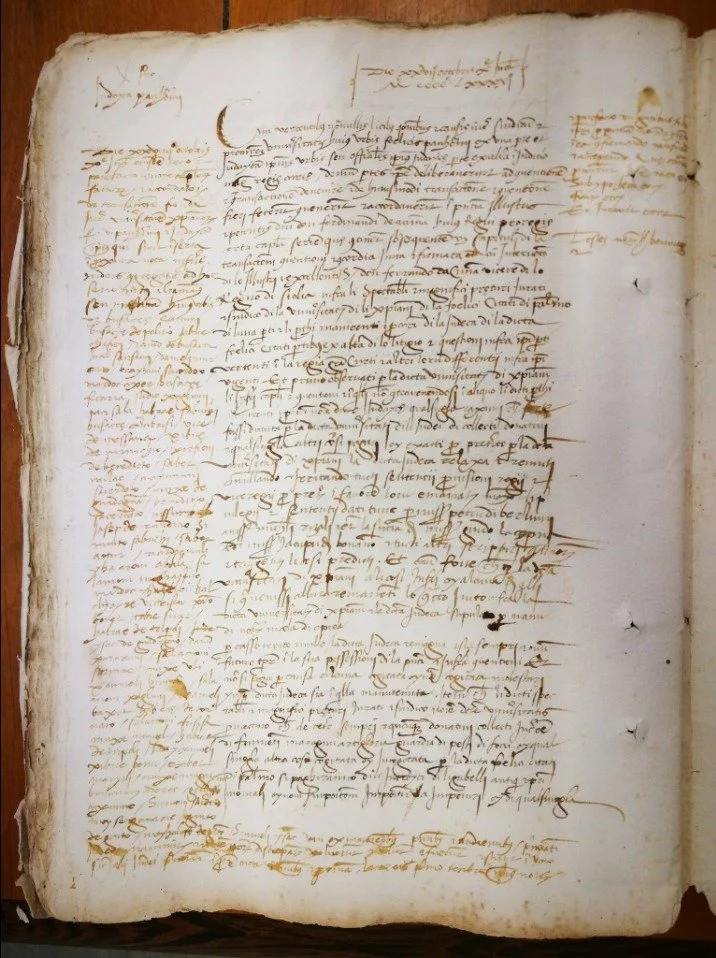
My cousin Steve Lucido, whom I'd never heard of until Facebook, has been working on a book about our family for more than a decade. He runs a Facebook group with more than three thousand Lucidos in it. In 2023 he hired a full-time professional archivist in Palermo to go through the notary records of the 1400s and 1500s, one page at a time. Part of the reason was to find the admiral's will. [FLAG: Steve's research is shared in a private Facebook group. Get his OK before this goes up, and offer to link the book when it's out.]
He hasn't found it. What he found instead is Giacomo.
Giacomo
Giacomo Lucido was born in the 1460s, give or take. He first shows up on paper in Palermo on October 18, 1491, as a witness to a notary entry, at a meeting with the Spanish viceroy of Sicily, Fernando de Acuña. The viceroys ran the island out of the Palazzo Steri, a fortress-palace near the Palermo waterfront, and Steve suspects that's where the meeting happened.
So the first time anyone in our line appears in writing, he's in the room with Spain's man in Sicily. Not an admiral. Not nothing, either.
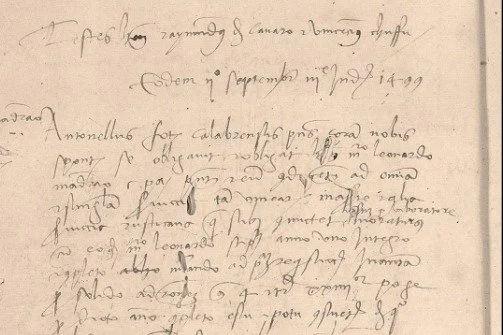
In 1496, Giacomo was appointed a notary. In fifteenth-century Sicily, a notary wasn't the person who stamps your mortgage papers at the bank. A notary wrote the city down: sales, leases, dowries, loans, wills, all by hand, all kept on file. If two people in Palermo made a deal that mattered, a notary wrote it.
What else we know about him:
Around 1498 he married Margherita Bonamoneta, whose family ran Palermo's tonnara, the city's tuna fishery. Her father and grandfather were notaries, too. (Nepotism: also a family tradition.)
In April 1498 he leased a shop at the corner of Vicolo Malcoquinati, facing the Genoese lodge, the trading house for merchants from Genoa, in the busiest commercial stretch of the port. Rent: six onze a year. (An onza was a Sicilian gold coin. I have no idea whether that was a lot. Steve probably does.)
He traded wine grapes on the side.
He lived in the Kalsa, the old quarter behind the Steri.
The earliest document we have in his own handwriting is dated September 7, 1499.
His children were all recorded as nobles. Steve thinks the family most likely bought the title, which was common in Sicily at the time, instead of earning it the old way, as a knight in the king's service. I choose to find this charming.
Here's the part I can't let go of. The admiral's story ends with a will. Wills don't write themselves. In Palermo around 1500, the person who wrote your will was a notary.
I'm not saying Giacomo wrote the admiral's will. Nobody has found it, and I'm not going to invent it for a blog post. I'm saying that if the legend is true, somebody in a notary's shop wrote it down. And for three generations in Palermo, the notaries were us.
Somebody in this family has always been the one writing it down.
The doodle
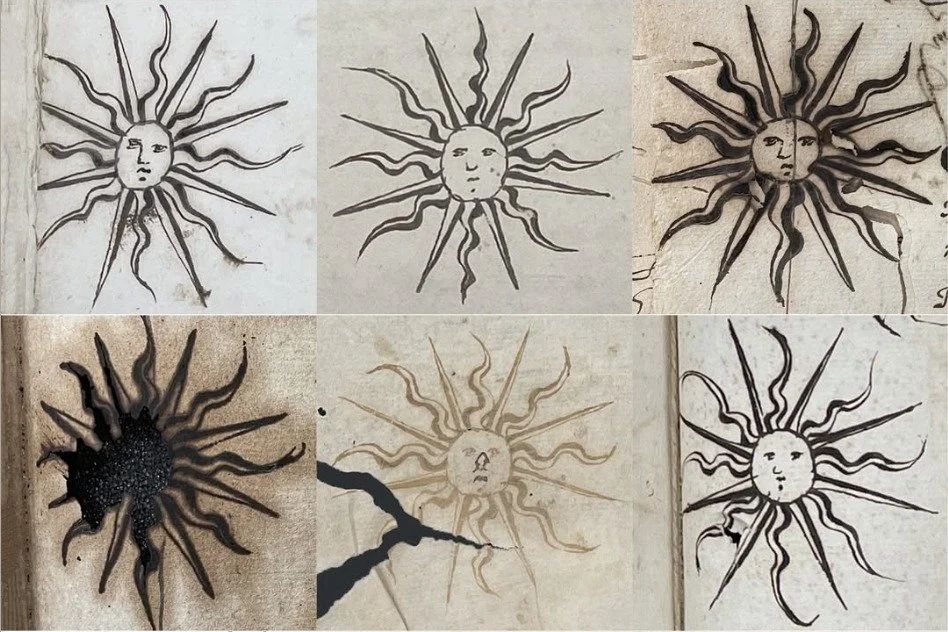
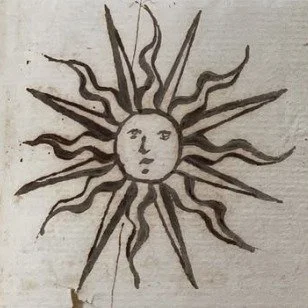
Giacomo's grandson, also Giacomo, born around 1540, was the third generation of notaries in Palermo. Notaries back then used a signum tabellionis: a hand-drawn mark next to their name, part signature and part logo. Giacomo drew his on some of his entries from July 4, 1560, to August 3, 1567. Steve put them side by side in a collage, and you can watch the mark change over seven years.
A young man with a new job, redrawing his signature until it looked right.
The mark is a sun, with a bunch of rays coming out of it and a Mona Lisa smile. It's so cool.
I doodled that sun a lot as a kid. Over and over, never knowing it had been my family's symbol (or doodle?) for the better part of five hundred years. When I saw it on Steve's page, I got chills.
I've redrawn my own signature the same way, until it felt right. These days I do it with the Analog Arrivals stamp. [LINK: Analog Arrivals]
In the early 1580s he left Palermo for Capaci, a new village up the coast that the local baron was trying to fill with people, and married Violante Taormina around 1583. By Steve's count, about three quarters of the people in the family group descend from those two. Over the next four and a half centuries, their descendants spread across northwest Sicily, including Terrasini, the fishing town my side of the family comes from.
Then the pen goes quiet for a long time.
Four hundred years of fish
For most of those centuries, the Lucidos Steve has traced were fishermen. Not notaries. Not admirals. Fishermen, on the tuna fisheries and the coast, and later on Cannery Row in Monterey, California, where Lucidos and their descendants helped drive the sardine boom.
The 1918 flu went through Terrasini. One mother there died two months after her last son was born, and her children ended up in Michigan and Massachusetts.
This is where the theory should fall apart, and I'd rather say so before anyone else does. Writing isn't in the blood. Generations of Lucidos hauled nets for a living, and nobody asked them whether they could draw. I'm not claiming a gene for prose.
My side fits the pattern. My great-grandparents came over from Terrasini by way of Gloucester, Massachusetts. They were fishermen in Italy and fishermen in Mass. I don't know when, exactly.
They brought a legend of their own. Apparently one guy stabbed another in a bar fight in Sicily. Years later they saw each other again in Massachusetts and realized they were cousins. I don't know if it's true. It's about as well documented as the admiral.
Nothing else made the trip. Not even family, really. No Lucido cousins or aunts or uncles alive on my side. (Steve counts, technically. I don't know him at all.) The Facebook page is really the first I learned about so much of it.
And the writing in my house didn't come from the Lucidos. Papa Joe and my dad are singers. It was my mom's dad who wrote lots of letters to friends, and that always inspired me. Nobody else drew. Nobody showed me how. I taught myself, and as far as I know nobody kept any of it.
So what I'd claim is smaller. It isn't blood, and it isn't how I was raised. It's a choice. Somebody decides to be the one who keeps the record.
Though I did draw that sun.
Here I am
I write. I draw. I make mail art out of ink, collage and colored pencil and leave it in shops for strangers. [LINK: Analog Arrivals] Right now my table has mail art in progress, pens, ink, colored pencils and a laptop running LUCID. [LINK: Becoming Lucid] Here I am today with LUCID and my content engine, voice, and all these other tools I'm building.
Every part of a piece of mail art feels like the family trade. The writing. The drawing. The stamp on the back. And leaving it for a stranger, the way a notary files a record for people he'll never meet.
But the most Lucido thing happening right now isn't mine. It's Steve's book: hundreds of pages, thousands of family photos, a family written down one record at a time by a guy who hired a professional to read the handwriting of a notary who first signed his name in 1499.
Giacomo would recognize the job.
The will is still out there somewhere. Steve's still looking. If he finds it, I hope it leaves everything to the secretary.
I'm writing it down.