Somewhere in the middle of my setlist, between one of my originals and a Bob Dylan cover, there's a line that just says [dialogue].
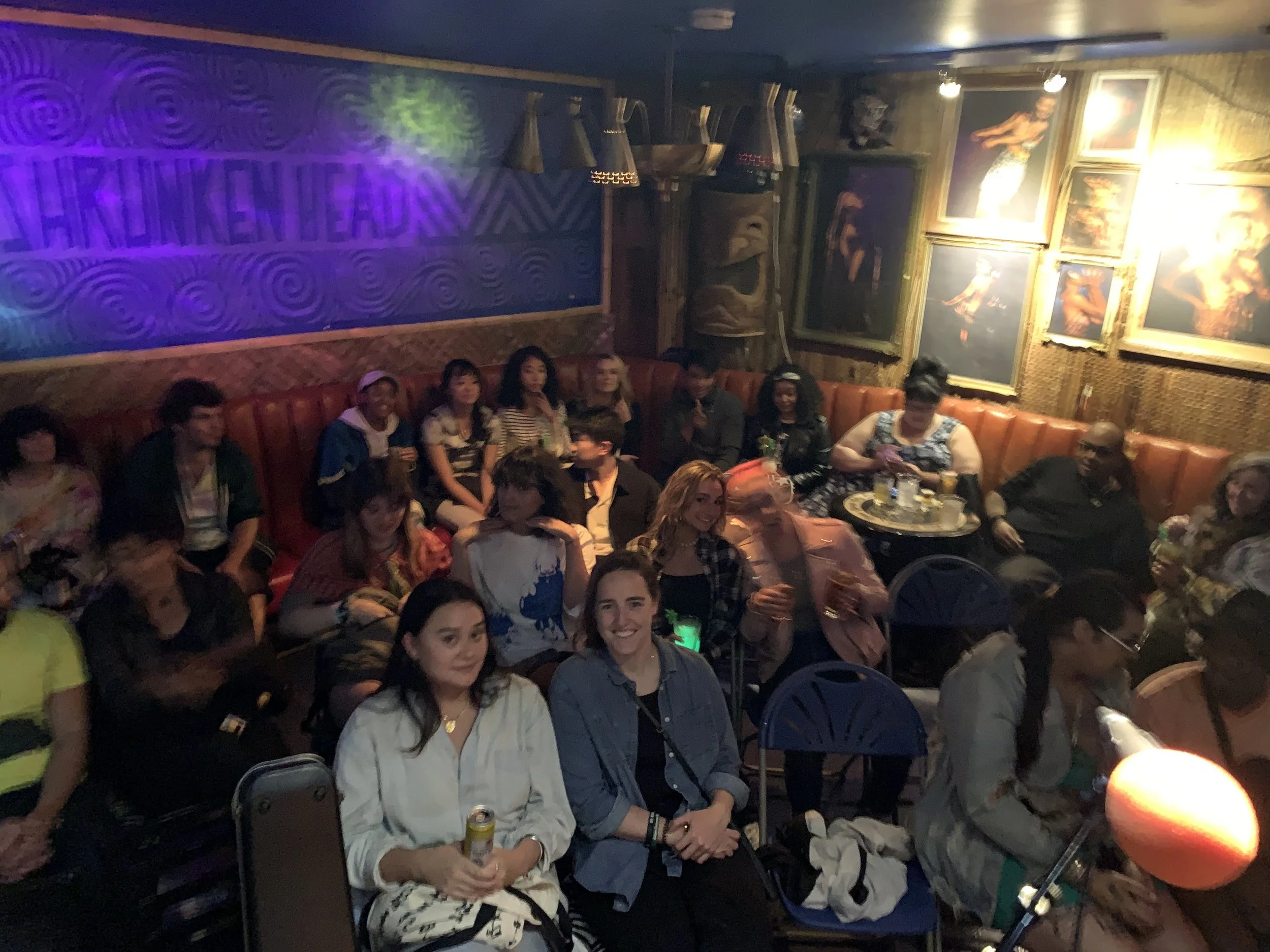
Otto’s NYC
That's where I talk. It's the only slot in the set I've never rehearsed, and I've never had to. Talking to a room is the one part of this that has always come easy.
Here's the whole thing, in order, because a setlist is the most honest document a musician owns:
"Minstrel Boy" (traditional Irish), which runs straight into
"Irish Song" (mine), which runs straight into
"Bishop" (mine)
[dialogue]
"Don't Think Twice, It's All Right" (Dylan, but my version)
"Julie" (mine, language warning)
"All Systems Go" (Standish Arms)
A Greg Holden cover (TBD)
"Monster Moon" (mine)
A new song (TBD)
Before any of that, I check the mic with "I've Just Seen a Face," a Beatles song from 1965 that moves fast enough to tell me whether my hands are awake. If there's an encore, it's "Don't Look Back in Anger," because every guy with an acoustic guitar is legally required to know one Oasis song, and I picked the one where the crowd does the heavy lifting.
The math
Two of my ten songs are TBD. That's twenty percent of the set held together by optimism.
"Julie" has a few words in it that don't belong in front of a family crowd, so on family nights she sits out and the set is nine songs long. Nobody is counting but me. I'm always counting.
The first three songs are one continuous piece, about ten minutes with no gap for applause, which is either confidence or a clever way to avoid finding out.
"Bishop" is not about church. It's about the chess piece. (A bishop moves on the diagonal and never changes color. Do with that what you will.)
"All Systems Go" belongs to a band called Standish Arms, which, if I remember right, took its name from a hotel in a Hemingway novel.
Why "Minstrel Boy" goes first
"Minstrel Boy" is a two-hundred-year-old Irish song about a kid who goes off to war with his harp, gets killed, and tears the strings out on the way down so the enemy can never play it.
I open with that. Then I segue into an original.
It goes first for two reasons. The practical one: it opens up my voice, and it grabs a room faster than anything else I know. The real one: my mom taught it to me when I was a kid. She plays guitar. We're an Irish family, and that song matters in it.
It was also supposed to be our Saint Patrick's Day song back when I was in a band called the Brothers Kelly. That plan did not take off. The song stayed anyway.
The honest part
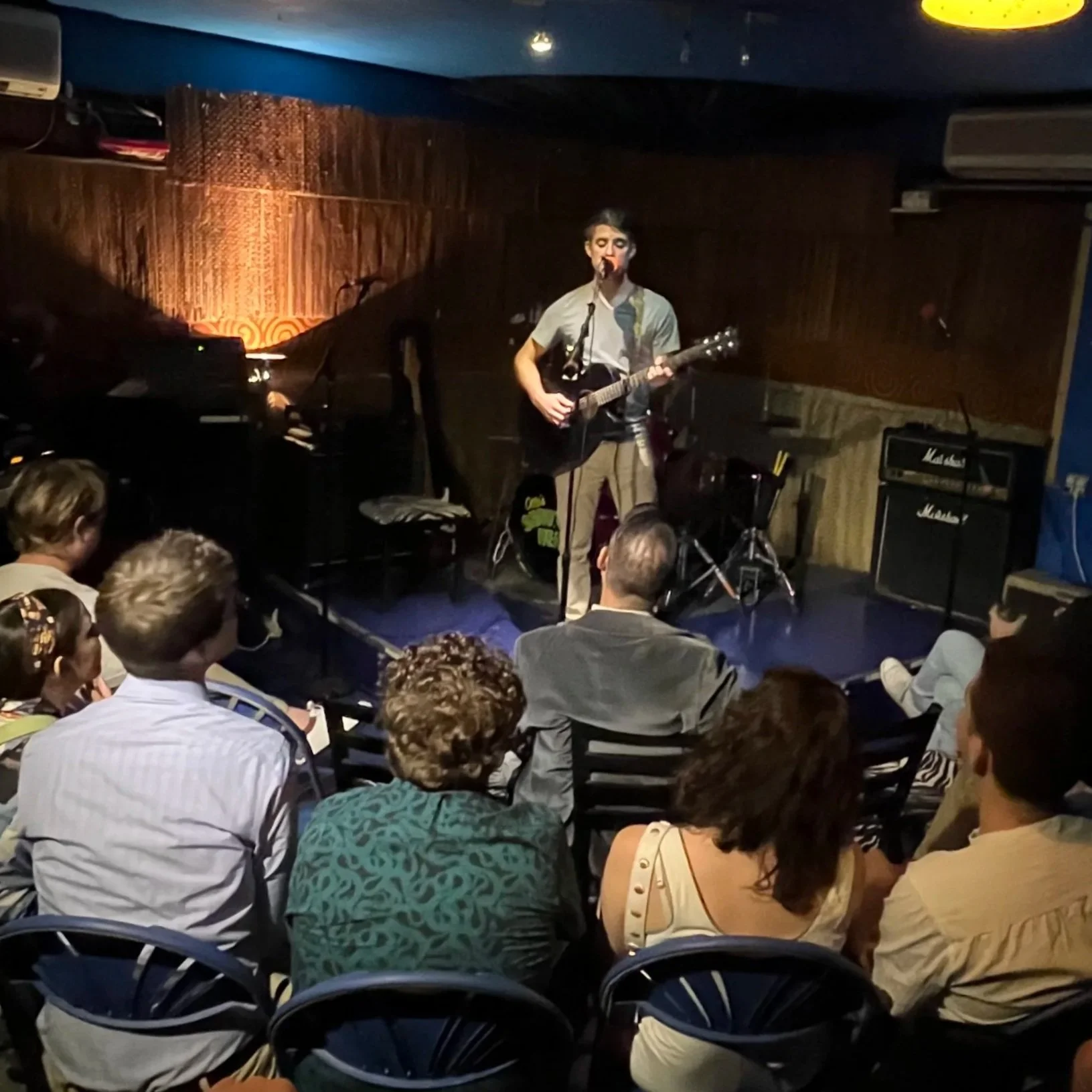
I play a black Martin narrow-body acoustic-electric through a Fender acoustic amp. There's a Boss looper on my floor that I own, understand in principle, and have not yet worked into the set. It sits there like a dog waiting to be walked.
About the playing itself: I'd call my guitar mediocre overall, with two exceptions. I'm solid on chords, and I'm good at hammer-ons. That's not modesty. That's an inventory.
The covers I keep in my back pocket read like the CD wallet in a 2003 Honda Civic: a few Dispatch songs, three Ben Harper songs, "Santeria," "Hit the Road Jack," "I'll Follow You Into the Dark." (If you're under thirty, a CD wallet was a zippered binder of plastic sleeves you kept on the sun visor. It was a whole personality.) The ones I'm learning next are "Jolene," "Landslide" and "Where Is My Mind," which is less a playlist than a mood ring.
Where it lives
I've played open mics at Otto's Pub in New York, and at others in New York, Chicago, Florida and Detroit. The newest one on the list is The Congregation, a coffee shop in a converted church in Detroit. Playing original songs in a room that used to be a sanctuary is exactly as funny as it sounds, and no, "Bishop" still isn't about that.
What I want next is a coach: one person who'll watch the whole set once and tell me the three cheapest fixes. Not a makeover. The lowest-hanging fruit. Somebody to tell me whether [dialogue] should get longer or disappear.
The TBDs are still TBD.